
Understanding the environmental changes and how to adapt plays a crucial role for small-scale farmers to secure the cash crop, one of the most important is the Cashew nuts.
The idea behind the Cashew Processing is to develop local capacities in key areas of sustainable cashew production.
Cashew has a nut and an apple.
The apples are often used locally in making juice and jam.
The nuts are often sold raw through middlemen, which limits the farmer’s income, and a few are processed and sold on the local market.
In 1987, ADPP-GB decided to move to the Oio Region and established a commercial cashew plantation. In this connection, 900 farmers were trained, and it has positively impacted the production of Cashew in Guinea-Bissau.
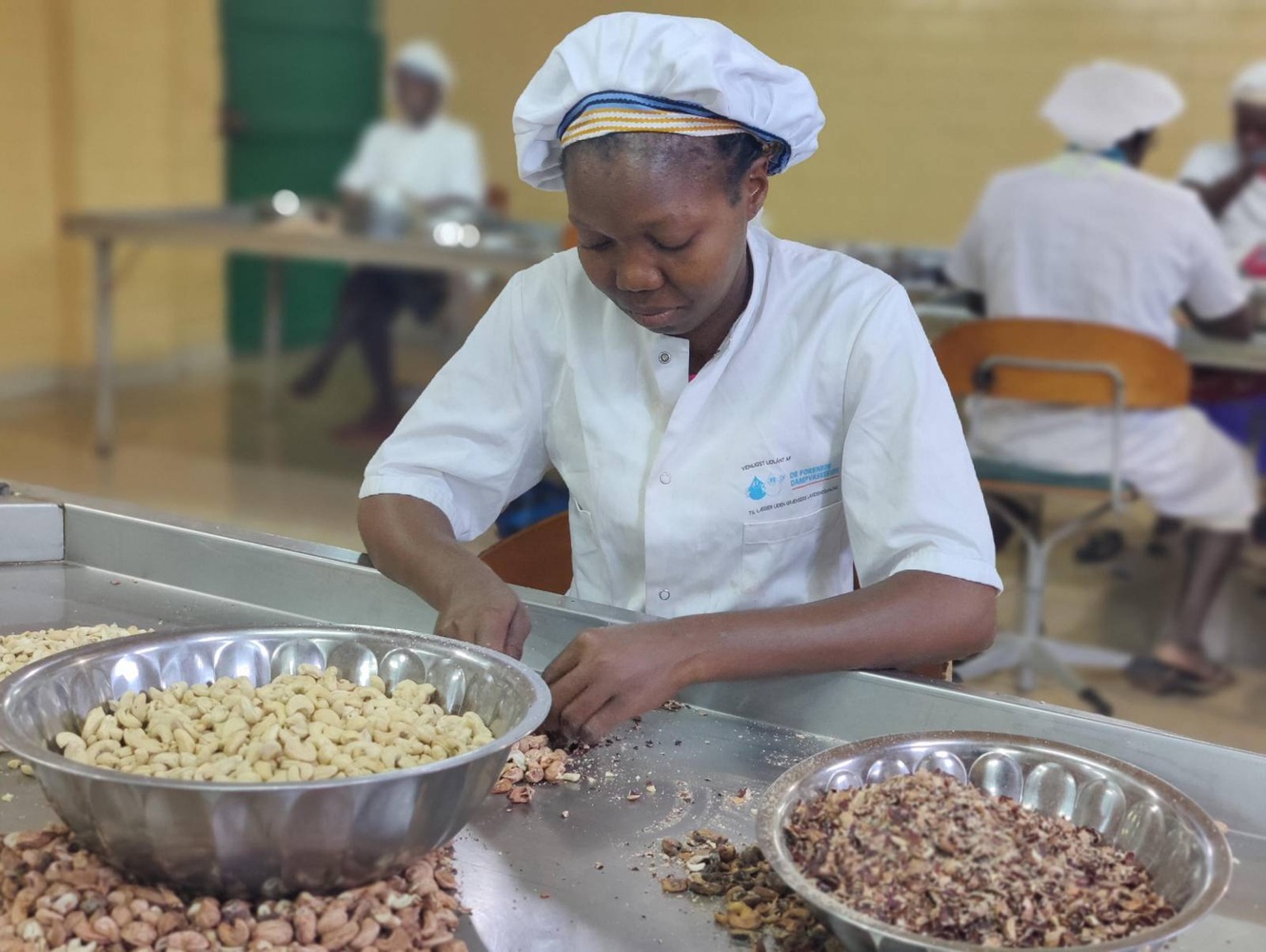
In 2016, with the support of the European Union, a small processing centre was established to support the farmers in increasing the price of the nuts exported as processed nuts.
ACACB was established (Associação de Clubes de Agricultores Comerciais de Bissorã), which owns and runs the processing centre.
In 2025, ADPP-GB employed 4 people in the plantations to monitor the maintenance of the plantations and the harvests.
The plantations were hired out to 148 local farmers to make the collection of the nuts.
For each kilo of clean nuts produced, four kilos of raw nuts are needed.
The process of getting the raw nuts is as follows:
- Remove the nut from the apple.
- Nuts are dried.
- Nuts are cooked and dried again.
- Nuts are cut open and removed from their shells.
- The clean nuts without the shells are dried for hours, and after that, peeled.
- Finally, the nuts are sorted into categories, packed and made ready for sale.
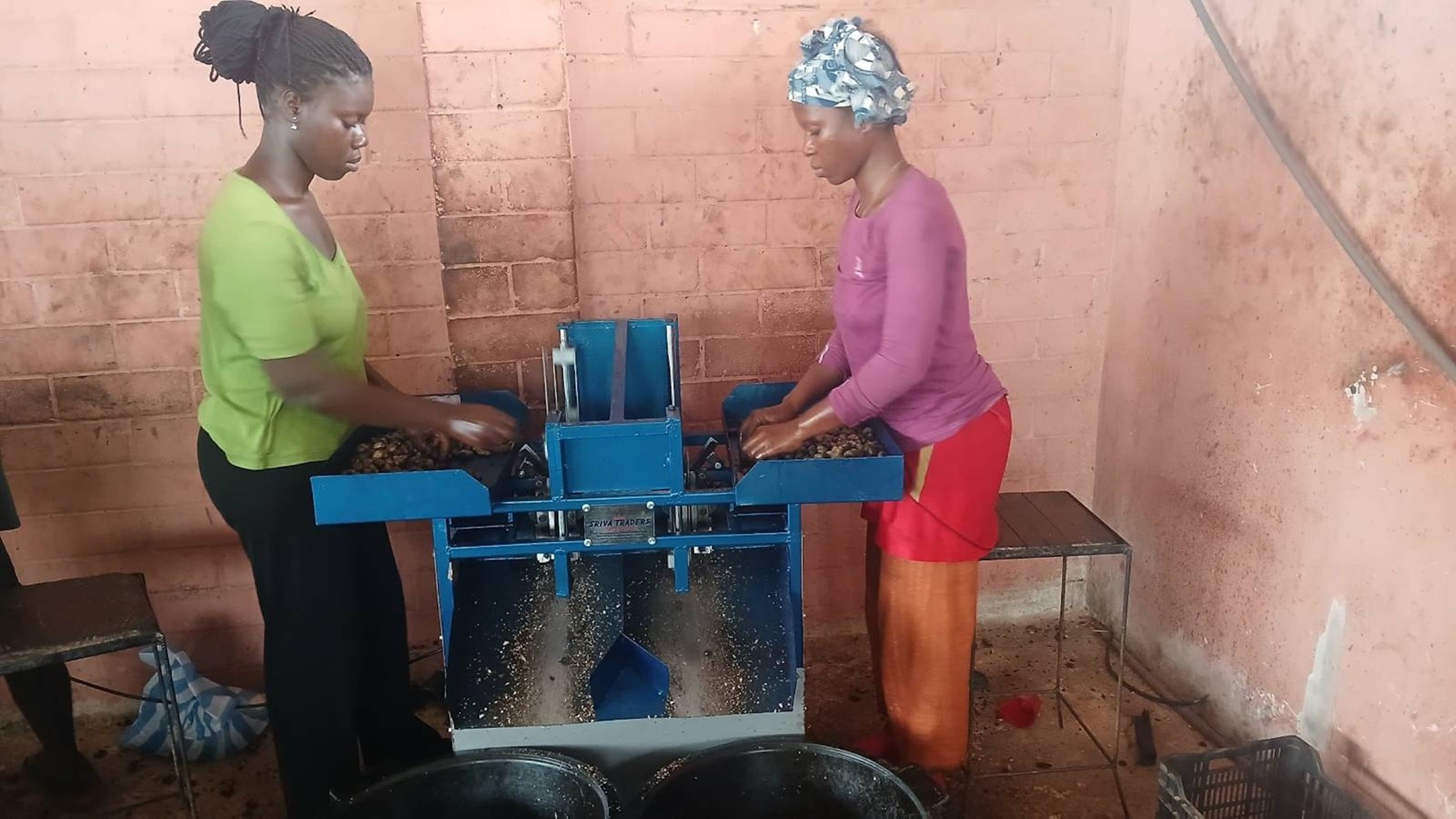
In 2025, 57 women and 48 men were employed in the processing centre, and 4 containers were exported to German company Naturkost Ernest Weber, which buys the biggest nuts.
40% of the nuts are sold on the local market.
In 2025, 157 tons of nuts came to the factory from the ADPP-GB plantation.
Supported by:
Humana People to People partners